
Responsible AI & Human Agency · Research · 2026Verantwoorde AI & menselijke regie · Onderzoek · 2026
Meaningful Human Oversight in AI
Human agency, not human presence.
This research page is currently available in English only. Research position as of 3 October 2026 — governance analysis, not legal advice.Deze onderzoekspagina is op dit moment alleen in het Engels beschikbaar. Onderzoekspositie per 3 oktober 2026 — governance-analyse, geen juridisch advies.
The argument in 60 seconds
A person clicking “approve” does not prove that a human meaningfully controlled an AI-assisted decision.
The real question is whether that person understood what the system could and could not know, had enough time and evidence to reach an independent conclusion, and had the authority to disagree, override or stop the system.
But operator control is only half the question. The person affected by the decision also needs agency: notice, understandable reasons, the chance to add context, access to a human, correction, contestation and effective remedy.
Human oversight is meaningful only when human accountability is matched by human knowledge, capacity and authority.
Research question: when does human involvement in an AI-assisted decision actually amount to meaningful oversight?
The human-agency model
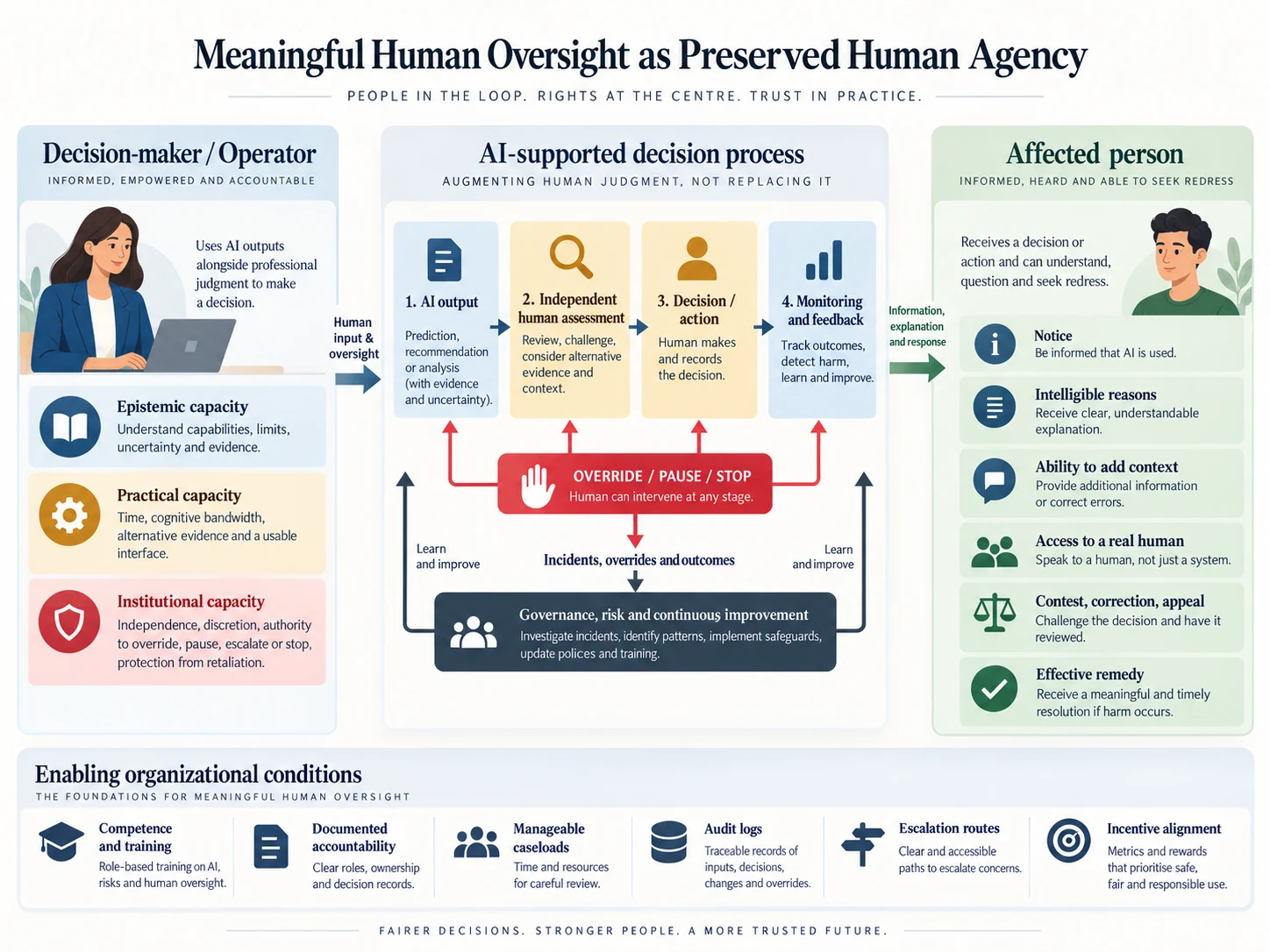 View the full model →
Decision-maker
- Epistemic capacity — understand capabilities, limits, uncertainty and evidence
- Practical capacity — time, attention, alternative evidence and a usable interface
- Institutional capacity — independence, authority to override, pause, escalate or stop, and protection from retaliation
Decision process
- AI output, with evidence and uncertainty
- Independent human assessment
- Decision, recorded with reasons
- Monitoring and feedback
Override · pause · stop available at every stage; incidents and overrides feed governance.
Affected person
- Notice
- Intelligible reasons
- Ability to add context
- Access to a real human
- Contest, correction, appeal
- Effective remedy
Three questions capture the operator's side:
- Epistemic capacity
- Do I know enough to judge?
- Practical capacity
- Do I realistically have the time, evidence and tools to judge?
- Institutional capacity
- Am I genuinely allowed to disagree?
And a chain for the affected person:
notice → reasons → context → human access → contest → correction → appeal → remedy
Operator oversight alone can fail because an operator may overlook missing context, share the organisation's incentives or see only evidence the AI selected. The affected person may hold the decisive information — wrong identity data, changed circumstances, a disability accommodation — that neither model nor operator can see.
Why “human in the loop” is not enough
| Term | What it describes | Why it can fall short |
|---|---|---|
| Human-in-the-loop | A person approves or rejects an output at a case-level step | Says nothing about knowledge, time, independence or authority |
| Human-on-the-loop | A person supervises and intervenes in exceptions | Rare-event monitoring erodes vigilance and takeover readiness |
| Human-in-command | Humans control purpose, deployment, limits and retirement | Stronger, but abstract unless authority is tested in practice |
| Human review | Reconsideration of an output or decision | Can be hurried, AI-framed or merely procedural |
| Contestability | Ability to challenge an output, decision or use | Ceremonial without reasons, evidence or power to correct |
| Remedy | Correction, reconsideration, compensation or cessation | Review without an outcome-changing remedy does not restore agency |
| Human agency | Capacity to understand options, form a judgement and act on it | The broadest — and most useful — organising concept |
“In the loop” is an architectural description. “Meaningful” is a substantive judgement about whether agency exists.
What European law already asks
EU AI Act, Article 14. High-risk systems must be designed so people assigned to oversight can understand capabilities and limitations and detect anomalies; stay aware of automation bias; interpret outputs correctly; decide not to use the system or disregard, override or reverse its output; and intervene or stop it safely. For certain remote biometric identification systems, an identification must be separately verified by at least two competent people before action is taken.1
Deployers (Article 26) must assign oversight to people with the necessary competence, training and authority, and give them support; Article 27 requires certain deployers to assess fundamental-rights impacts, including oversight arrangements, before use.2 Following the AI Omnibus, these high-risk obligations apply from 2 December 2027 for Annex III systems and 2 August 2028 for systems in regulated products.3
GDPR Article 22 protects people against decisions based solely on automated processing with legal or similarly significant effects, and where exceptions apply requires at least the right to human intervention, to express one's view and to contest the decision.4 European data-protection guidance is explicit that involvement must be meaningful rather than a token gesture, carried out by someone with the authority and competence to change the decision.5 In SCHUFA, the EU Court of Justice held that a credit score can itself be an automated decision when the recipient draws strongly on it.6
The Council of Europe Framework Convention grounds AI governance in dignity, autonomy, transparency, oversight and accountability, and requires information sufficient for affected people to challenge decisions and effective procedural safeguards.7
Global frameworks converge: the NIST AI Risk Management Framework treats human roles and oversight as part of lifecycle governance,8 the OECD AI Principles call for human agency and oversight and the ability to challenge outcomes,9 and UNESCO's Recommendation holds that ultimate responsibility must not be displaced from humans.10 Europe's distinctive contribution is enforceable rights, complaint and remedy; NIST and OECD add more explicit attention to incentives and lifecycle governance.
The human can be present and still have no agency
Rubber-stamping is usually a system-design problem, not a bad-employee problem.
- Automation bias appears in single-task and multitask settings, especially when checking is cognitively complex.11
- Advice changes values, not just predictions. In an experiment with 2,140 participants, risk scores made people weigh risk differently: racial disparity in simulated pretrial detention rose by 1.9%, and simulated government aid fell by 8.3%.12
- Explanations help only when checking them is cheap. Across five studies (N = 731), overreliance depended on the effort required to verify an explanation and on incentives for accuracy.13
- Cognitive forcing works, but people dislike it. Asking for a judgement before showing the AI's reduced overreliance; participants preferred the less demanding designs.14
Organisational mechanisms that turn review into ritual:
- AI recommendation shown before any independent view
- Too little time, too many cases
- Overriding takes more clicks or justification than accepting
- Targets reward speed or conformity
- Reviewers see only model-selected evidence
- Uncertainty presented as precision
- Fear that departing from the model creates personal liability
- Weak escalation routes and gradual deskilling
The last point connects to my research on when AI assistance becomes human dependency: oversight assumes a competence that sustained automation can quietly erode.
What real cases show
- Robodebt (Australia)
- A Royal Commission examined the unlawful automated debt scheme and its effects on welfare recipients.15 Human administration cannot cure an unlawful automated premise.
- Childcare benefits (Netherlands)
- The Dutch Data Protection Authority found that the tax authority processed nationality data in a discriminatory and unlawful way.16 Human involvement does not neutralise biased data or institutional pressure.
- SCHUFA (EU)
- A score can be an automated decision when a downstream human relies on it decisively.6 A nominal decision-maker does not break automation.
- Uber drivers (Amsterdam Court of Appeal, 2023)
- In account-deactivation cases, the court held that genuine human intervention had not been sufficiently shown, noting that drivers were not heard and the reviewers' qualifications were not explained.17 Review must be demonstrably independent and capable of changing the outcome.
- Bridges v South Wales Police (UK)
- Officers confirmed facial-recognition matches, yet the Court of Appeal found the legal framework governing discretion deficient.18 Human confirmation does not cure inadequate legal boundaries.
- Automated test vehicle fatality (Tempe, 2018)
- The NTSB investigated failures involving the automated driving system, operator monitoring and organisational safety culture.19 A human-on-the-loop is a weak last resort when vigilance and takeover are not designed for.
- iTutorGroup (United States)
- The EEOC alleged software automatically rejected older applicants; the case settled for $365,000.20 High-impact screening needs testing and challenge before rules operate at scale.
The Meaningful Human Oversight Test
A proposed governance model, not a statutory interpretation.
| Dimension | Evidence of meaningful oversight | Red flags |
|---|---|---|
| 1. Information | Reviewer sees provenance, material evidence, known limits, uncertainty and model version | Only a score, label or polished explanation |
| 2. Independent judgement | Reviewer can form a view before seeing the recommendation, where feasible | AI output is the default anchor |
| 3. Competence | Role-specific training and demonstrated understanding of failure modes | Generic AI-awareness course only |
| 4. Time and capacity | Caseload and decision time validated through realistic testing | Success measured mainly by throughput |
| 5. Alternative evidence | Reviewer can inspect raw or independent evidence and request context | All evidence selected or ranked by the same model |
| 6. Discretion | No target override rate; disagreement needs no disproportionate justification | Overrides hurt performance ratings |
| 7. Authority | Reverse, pause, escalate and stop are tested in the live workflow | “Stop” exists only in documentation |
| 8. Accountability and learning | Reasons, overrides, incidents and later outcomes are logged and analysed | Approval logged; reasoning and corrections not |
| 9. Affected-person agency | Notice, reasons, context, human access, correction, appeal and remedy work | Chatbot loops; appeals re-run the same model and data |
| 10. Institutional protection | Escalation routes, non-retaliation and senior governance access | Reviewer carries responsibility without backing |
Use a weakest-link assessment, not an average score. Excellent documentation cannot compensate for an inability to stop the system.
Minimum conditions for high-impact decisions
Oversight should not be called meaningful if any of these is missing: understandable information; a competent, resourced reviewer; independent access to evidence; practical discretion to disagree; tested authority to change or halt the result; documented accountability; effective contestation and remedy.
Maturity levels
- AbsentNo case-level oversight and no compensating lifecycle governance.
- CeremonialApproval exists, with little information, time, independence or power.
- ProceduralRoles, training and escalation are documented; effectiveness is not shown.
- EmpoweredIndependent judgement, alternative evidence and intervention authority are routinely tested.
- AdaptiveOperator and affected-person agency are measured; incidents, appeals and overrides drive redesign, restriction or withdrawal.
These are descriptive stages, not a numerical score — a score would contradict the weakest-link rule.
What leaders should require
- Boards and executives
- Realistic challenge-and-override exercises; reviewer workload and time-on-task; known-error detection rates; appeal outcomes; stop-test results; outcome disparities; protection for staff who challenge; named authority to suspend.
- Product and interface teams
- Independent assessment before the recommendation where proportionate; visible uncertainty and limits; challenging takes no more effort than accepting; explicit pause, override and escalate; reasons preserved; explanations based on the actual decision.
- Operations
- Oversight resourced as work: validated caseload limits, protected review time, expert escalation, manual fallback, failure simulations, no incentives that reward rubber-stamping.
- Procurement
- Input, output and version logs; documented limits; notice of model changes; audit and testing rights; incident notification; support for explanation, correction and appeal; deployer control over suspension and exit.
Redesign or suspend when reviewers cannot explain why decisions changed, known test errors are repeatedly missed, overrides become practically impossible, appeal reversals reveal systematic defects, or workload exceeds validated assumptions.
Human accountability should never exceed human knowledge, capacity or authority.
Method and limits
This is a research-led synthesis of legislation, case law, regulatory guidance and empirical research, prepared in October 2026. It is not legal advice. Legal status is described as of 3 October 2026 and may change. I checked each source below against its official or published record. The agency model, the ten-dimension test, minimum conditions and maturity levels are my own proposals.
Sources
- Legislation Regulation (EU) 2024/1689 (AI Act), Article 14 — Human oversight. artificialintelligenceact.eu · eur-lex.europa.eu. ↩
- Legislation AI Act, Articles 26 and 27 — deployer obligations and fundamental-rights impact assessment. Article 26 · Article 27. ↩
- Official guidance European Commission. AI Act — regulatory framework for AI (including AI Omnibus dates). digital-strategy.ec.europa.eu. ↩
- Legislation Regulation (EU) 2016/679 (GDPR), Article 22. eur-lex.europa.eu. ↩
- Regulatory guidance Article 29 Working Party / EDPB, Guidelines on Automated individual decision-making and Profiling (WP251rev.01). ec.europa.eu. ↩
- Case law CJEU, Case C-634/21, SCHUFA Holding (Scoring), 7 December 2023. eur-lex.europa.eu. ↩
- Treaty Council of Europe Framework Convention on Artificial Intelligence (CETS No. 225). coe.int. ↩
- Framework NIST (2023). AI Risk Management Framework (AI RMF 1.0). doi:10.6028/NIST.AI.100-1. ↩
- International principles OECD AI Principles. oecd.ai. ↩
- International recommendation UNESCO (2021). Recommendation on the Ethics of Artificial Intelligence. unesco.org. ↩
- Systematic review Lyell, D. & Coiera, E. (2017). Automation bias and verification complexity: a systematic review. JAMIA, 24(2), 423–431. doi:10.1093/jamia/ocw105. ↩
- Experiment Green, B. & Chen, Y. (2021). Algorithmic risk assessments can alter human decision-making processes in high-stakes government contexts. Proc. ACM HCI (CSCW). arXiv:2012.05370. ↩
- Experiment Vasconcelos, H. et al. (2023). Explanations can reduce overreliance on AI systems during decision-making. Proc. ACM HCI (CSCW). arXiv:2212.06823. ↩
- Experiment Buçinca, Z., Malaya, M. B. & Gajos, K. Z. (2021). To trust or to think. Proc. ACM HCI, 5(CSCW1). doi:10.1145/3449287. ↩
- Public inquiry Royal Commission into the Robodebt Scheme (2023). Report. robodebt.royalcommission.gov.au. ↩
- Regulatory action Autoriteit Persoonsgegevens. Boete Belastingdienst voor discriminerende en onrechtmatige werkwijze. autoriteitpersoonsgegevens.nl. ↩
- Case law Gerechtshof Amsterdam, 4 April 2023, ECLI:NL:GHAMS:2023:793 (Uber drivers). rechtspraak.nl. Related: ECLI:NL:GHAMS:2023:804 (Ola). ↩
- Case law R (Bridges) v Chief Constable of South Wales Police [2020] EWCA Civ 1058. judiciary.uk. ↩
- Accident investigation National Transportation Safety Board. Investigation HWY18MH010 (Tempe, Arizona, 2018). ntsb.gov. ↩
- Regulatory action U.S. EEOC. iTutorGroup to pay $365,000 to settle EEOC discriminatory hiring suit. eeoc.gov. ↩