01
Why this exists
Waarom dit bestaat
Potential map and walking-route product
Photography archive + content taxonomy
 DAPHNE
What happens when language used to describe a group begins determining how that group is seen?
Research only
Explore the evidence, narrative method and media work. Collaboration is most relevant where cultural memory, public storytelling and responsible representation meet.
Follow the invitationVolg de uitnodigingPotential map and walking-route product
Photography archive + content taxonomy
Now:Nu: Photography archive + content taxonomy
Next:Volgende: Launch first 10 YouTube stories
Film event report producer
A field report shaped through film: documenting the walk as public memory, civic movement, and lived testimony.
Primary source · Released under public disclosure
Primaire bron · Vrijgegeven via openbaarmaking
November 2020. Press conferences. Graphs. Infection numbers. Markings on supermarket floors. Posters at bus stops. Experts on television. We argued about what was true, what was necessary, and how long it would last.
November 2020. Persconferenties. Grafieken. Besmettingscijfers. Markeringen op de vloer van de supermarkt. Posters bij bushaltes. Deskundigen op televisie. We discussieerden over wat waar was, wat nodig was, en hoe lang het nog zou duren.
What almost nobody saw at the kitchen table were the documents behind the communication. One of them carried a remarkably matter-of-fact title.
Wat bijna niemand aan de keukentafel zag, waren de documenten achter de communicatie. Een daarvan droeg een opvallend zakelijke titel.
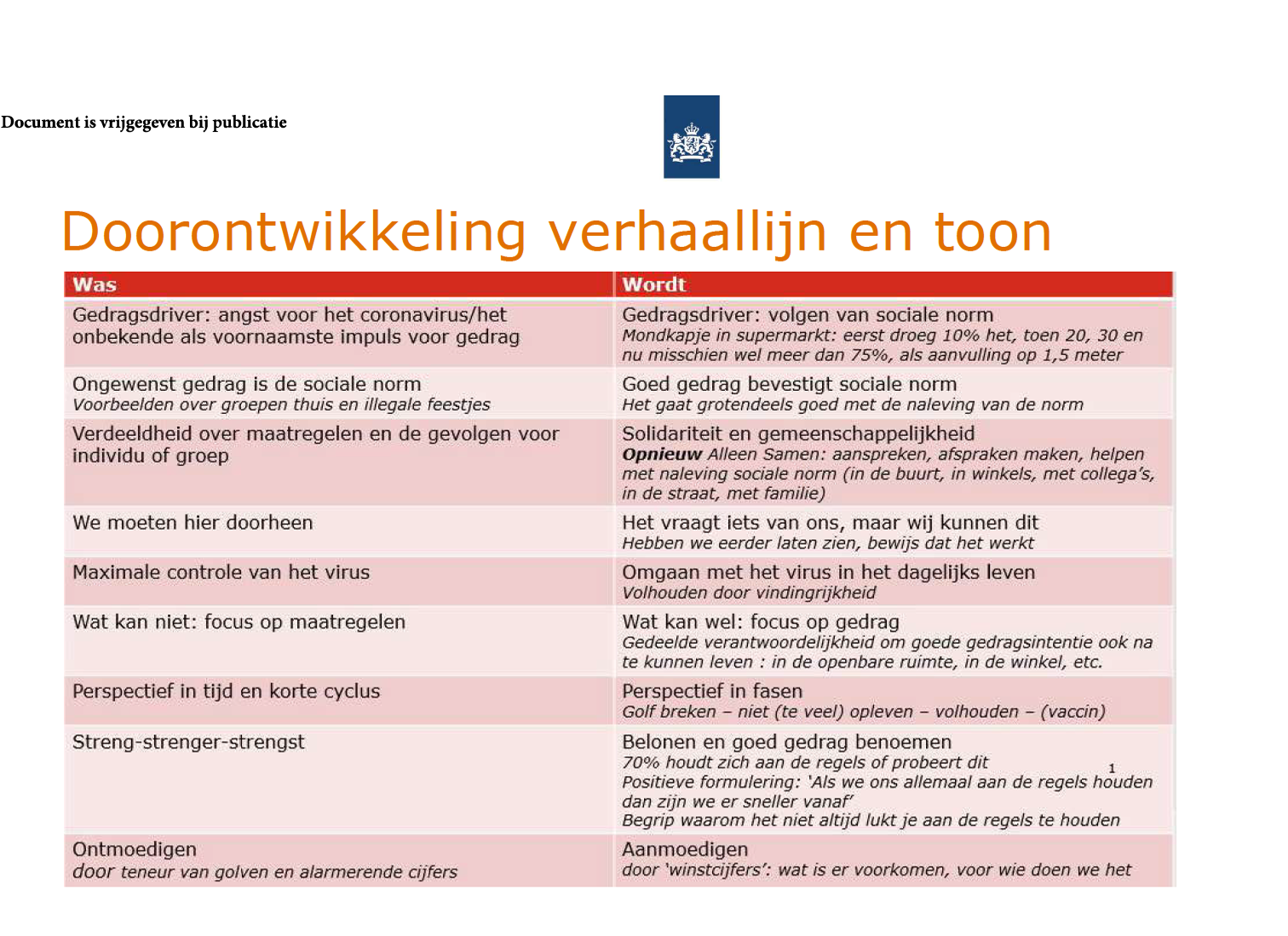
“Further development of the storyline and tone.”“Verdere ontwikkeling van de verhaallijn en toon.”Doorontwikkeling verhaallijn en toon
How to read this section
Hoe je dit onderdeel leest
This is not presented as proof that the government manipulated people. It is evidence that, while citizens debated measures, truth, fear and trust, there was also explicit internal thinking about the narrative through which behaviour could be influenced. That is a story about crisis communication, behavioural influence, social norms, trust and polarisation — not a verdict.
Dit wordt niet gepresenteerd als bewijs dat de overheid mensen heeft gemanipuleerd. Het is bewijs dat er, terwijl burgers discussieerden over maatregelen, waarheid, angst en vertrouwen, ook expliciet intern werd nagedacht over het verhaal waarmee gedrag kon worden beïnvloed. Dat is een verhaal over crisiscommunicatie, gedragsbeïnvloeding, sociale normen, vertrouwen en polarisatie — geen oordeel.
Nine planned shifts · Read the original language
Negen geplande verschuivingen · Lees de oorspronkelijke taal
Gedragsdriver: angst voor het coronavirus/het onbekende als voornaamste impuls voor gedrag
Gedragsdriver: volgen van sociale norm Mondkapje in supermarkt: eerst droeg 10% het, toen 20, 30 en nu misschien wel meer dan 75%, als aanvulling op 1,5 meter
What the document actually says. The slide identifies fear of the virus and of the unknown as an existing behavioural driver, then proposes moving communication toward another mechanism: following the social norm. That distinction matters. The document does not, by itself, prove that fear was deliberately manufactured. It does show that fear was explicitly recognised, named and planned around within governmental thinking about communication and behaviour.
Wat het document daadwerkelijk zegt. De slide benoemt angst voor het virus en voor het onbekende als bestaande gedragsdriver, en stelt vervolgens voor de communicatie te verschuiven naar een ander mechanisme: het volgen van de sociale norm. Dat onderscheid is belangrijk. Het document bewijst op zichzelf niet dat angst doelbewust werd gecreëerd. Het toont wel dat angst expliciet werd erkend, benoemd en meegenomen in het overheidsdenken over communicatie en gedrag.
Why the term matters. Perhaps the most revealing word here is not fear. It is behavioural driver. The question is no longer simply what information citizens should know. It also becomes what motivates citizens to behave a particular way — a mode of thinking governments also use in road safety, smoking, vaccination and public health. The harder question is where the boundary sits between legitimate public communication and behavioural steering, especially during a crisis marked by fear, uncertainty and unequal access to information.
Waarom deze term ertoe doet. Misschien is het meest onthullende woord hier niet angst. Het is gedragsdriver. De vraag is niet langer alleen welke informatie burgers moeten kennen. Het wordt ook wat burgers motiveert om zich op een bepaalde manier te gedragen — een manier van denken die overheden ook gebruiken bij verkeersveiligheid, roken, vaccinatie en volksgezondheid. De lastigere vraag is waar de grens ligt tussen legitieme publiekscommunicatie en gedragssturing, zeker tijdens een crisis die wordt gekenmerkt door angst, onzekerheid en ongelijke toegang tot informatie.
Gedragsdriver: angst voor het coronavirus/het onbekende als voornaamste impuls voor gedrag
Gedragsdriver: volgen van sociale norm Mondkapje in supermarkt: eerst droeg 10% het, toen 20, 30 en nu misschien wel meer dan 75%, als aanvulling op 1,5 meter
What the document actually says. The slide identifies fear of the virus and of the unknown as an existing behavioural driver, then proposes moving communication toward another mechanism: following the social norm. That distinction matters. The document does not, by itself, prove that fear was deliberately manufactured. It does show that fear was explicitly recognised, named and planned around within governmental thinking about communication and behaviour.
Wat het document daadwerkelijk zegt. De slide benoemt angst voor het virus en voor het onbekende als bestaande gedragsdriver, en stelt vervolgens voor de communicatie te verschuiven naar een ander mechanisme: het volgen van de sociale norm. Dat onderscheid is belangrijk. Het document bewijst op zichzelf niet dat angst doelbewust werd gecreëerd. Het toont wel dat angst expliciet werd erkend, benoemd en meegenomen in het overheidsdenken over communicatie en gedrag.
Why the term matters. Perhaps the most revealing word here is not fear. It is behavioural driver. The question is no longer simply what information citizens should know. It also becomes what motivates citizens to behave a particular way — a mode of thinking governments also use in road safety, smoking, vaccination and public health. The harder question is where the boundary sits between legitimate public communication and behavioural steering, especially during a crisis marked by fear, uncertainty and unequal access to information.
Waarom deze term ertoe doet. Misschien is het meest onthullende woord hier niet angst. Het is gedragsdriver. De vraag is niet langer alleen welke informatie burgers moeten kennen. Het wordt ook wat burgers motiveert om zich op een bepaalde manier te gedragen — een manier van denken die overheden ook gebruiken bij verkeersveiligheid, roken, vaccinatie en volksgezondheid. De lastigere vraag is waar de grens ligt tussen legitieme publiekscommunicatie en gedragssturing, zeker tijdens een crisis die wordt gekenmerkt door angst, onzekerheid en ongelijke toegang tot informatie.
Streng-strenger-strengst
Ontmoedigen door teneur van golven en alarmerende cijfers
Belonen en goed gedrag benoemen 70% houdt zich aan de regels of probeert dit. Positieve formulering: ‘Als we ons allemaal aan de regels houden dan zijn we er sneller vanaf’
Aanmoedigen door ‘winstcijfers’: wat is er voorkomen, voor wie doen we het
What the document actually says. Two rows describe a planned shift from an escalating, punitive register (“stricter–stricter–strictest,” discouragement through alarming case figures) toward reward, positive framing and naming compliance rates. The document frames this as a tone adjustment, not a change in the underlying measures.
Wat het document daadwerkelijk zegt. Twee rijen beschrijven een geplande verschuiving van een oplopend, bestraffend register (“streng-strenger-strengst,” ontmoediging via alarmerende cijfers) naar beloning, positieve framing en het benoemen van naleving. Het document omschrijft dit als een toonaanpassing, niet als een verandering van de onderliggende maatregelen.
What it doesn't establish. It does not show that earlier alarming figures were false or exaggerated for effect — only that officials discussed which tone, at which moment, might sustain public cooperation better than another.
Wat het niet aantoont. Het toont niet aan dat eerdere alarmerende cijfers onjuist waren of voor effect werden overdreven — alleen dat functionarissen bespraken welke toon, op welk moment, de publieke medewerking beter in stand zou kunnen houden dan een andere.
Verdeeldheid over maatregelen en de gevolgen voor individu of groep
Solidariteit en gemeenschappelijkheid Opnieuw Alleen Samen: aanspreken, afspraken maken, helpen met naleving sociale norm (in de buurt, in winkels, met collega’s, in de straat, met familie)
What the document actually says. This row proposes moving away from division over the fairness of measures and toward a “we're only getting through this together” frame, explicitly including citizens addressing and correcting one another's behaviour in shops, streets and families.
Wat het document daadwerkelijk zegt. Deze rij stelt voor om weg te bewegen van verdeeldheid over de rechtvaardigheid van maatregelen, richting een frame van “we komen hier alleen samen doorheen”, waarbij expliciet ook wordt genoemd dat burgers elkaar aanspreken en corrigeren op gedrag in winkels, straten en gezinnen.
What it makes us ask. Encouraging neighbours to hold each other accountable is a recognised public-health technique — and also a mechanism through which informal social pressure can be delegated from institutions to citizens themselves. Both readings are compatible with the same sentence.
Wat het ons doet afvragen. Buren aanmoedigen elkaar aan te spreken is een erkende techniek in de volksgezondheid — en ook een mechanisme waarmee informele sociale druk kan worden gedelegeerd van instituties naar burgers zelf. Beide lezingen zijn verenigbaar met dezelfde zin.
| Was | BecomesWordt |
|---|---|
| Gedragsdriver: angst voor het coronavirus/het onbekende als voornaamste impuls voor gedrag | Gedragsdriver: volgen van sociale norm |
| Ongewenst gedrag is de sociale norm | Goed gedrag bevestigt sociale norm |
| Verdeeldheid over maatregelen en de gevolgen voor individu of groep | Solidariteit en gemeenschappelijkheid |
| We moeten hier doorheen | Het vraagt iets van ons, maar wij kunnen dit |
| Maximale controle van het virus | Omgaan met het virus in het dagelijks leven |
| Wat kan niet: focus op maatregelen | Wat kan wel: focus op gedrag |
| Perspectief in tijd en korte cyclus | Perspectief in fasen |
| Streng-strenger-strengst | Belonen en goed gedrag benoemen |
| Ontmoedigen (door teneur van golven en alarmerende cijfers) | Aanmoedigen (door ‘winstcijfers’) |
Source: internal government communications slide, “Doorontwikkeling verhaallijn en toon,” released under public disclosure. Reproduced for critical analysis and public-interest research.
Bron: interne slide van overheidscommunicatie, “Doorontwikkeling verhaallijn en toon,” vrijgegeven via openbaarmaking. Gereproduceerd voor kritische analyse en onderzoek van algemeen belang.
Was this FUD?
Was dit FUD?
The document explicitly identifies fear of the virus and the unknown as a behavioural driver.
Het document benoemt expliciet angst voor het virus en het onbekende als gedragsdriver.
This communication existed inside an environment of considerable scientific, social and personal uncertainty.
Deze communicatie bestond binnen een omgeving met aanzienlijke wetenschappelijke, maatschappelijke en persoonlijke onzekerheid.
This is where the evidence gets weaker. These slides do not demonstrate that officials deliberately created false doubt, misinformation or uncertainty.
Hier wordt het bewijs zwakker. Deze slides tonen niet aan dat functionarissen doelbewust valse twijfel, desinformatie of onzekerheid creëerden.
In marketing, strategy and political communication, FUD — fear, uncertainty and doubt — describes communication where these psychological states shape decisions and behaviour. There is real overlap here, particularly around fear and uncertainty. But calling the entire strategy “FUD” would go further than the evidence allows. The primary source establishes that fear, social norms, framing and behavioural motivation were explicitly considered. The space between what a document actually proves and what we later infer from it is itself part of the W.A.P.P.I.E. story.
In marketing, strategie en politieke communicatie beschrijft FUD — fear, uncertainty and doubt (angst, onzekerheid en twijfel) communicatie waarbij deze psychologische toestanden gedrag en beslissingen sturen. Er is hier echte overlap, met name rond angst en onzekerheid. Maar de hele strategie “FUD” noemen zou verder gaan dan het bewijs toelaat. De primaire bron toont aan dat angst, sociale normen, framing en gedragsmotivatie expliciet werden overwogen. De ruimte tussen wat een document daadwerkelijk bewijst en wat we er later uit afleiden, is zelf onderdeel van het verhaal van W.A.P.P.I.E.
Beyond the slide
Voorbij de slide
The same materials describe how storyline and tone could travel through multiple layers of public communication — not just one press conference.
Dezelfde documenten beschrijven hoe verhaallijn en toon door meerdere lagen van publiekscommunicatie konden reizen — niet slechts één persconferentie.
For a citizen, these messages could appear to originate independently — an expert on television, a government campaign, a ministerial speech, a regional message, a social-media graphic. Behind the scenes, there was also central reflection about narrative, tone and desired behaviour. Click a channel to see how it fits.Voor een burger konden deze boodschappen onafhankelijk van elkaar lijken te ontstaan — een deskundige op televisie, een overheidscampagne, een ministeriële toespraak, een regionale boodschap, een infographic op sociale media. Achter de schermen was er ook centrale reflectie over verhaallijn, toon en gewenst gedrag. Klik op een kanaal om te zien hoe het past.
A minister's speech is where storyline and tone are first spoken aloud in public — the tone chosen here sets a register other channels often echo.De toespraak van een minister is waar verhaallijn en toon voor het eerst hardop in het openbaar klinken — de hier gekozen toon zet een register dat andere kanalen vaak overnemen. Ministers carry the storyline into cabinet-level communication, deciding which behavioural framing gets national visibility.Ministers dragen de verhaallijn de kabinetscommunicatie in en bepalen welke gedragsmatige framing landelijke zichtbaarheid krijgt. Regional authorities adapt national tone to local conditions — the same “social norm” framing, phrased for a specific city or province.Regionale overheden passen de landelijke toon aan lokale omstandigheden aan — dezelfde “sociale norm”-framing, verwoord voor een specifieke stad of provincie. Sector organisations (retail, hospitality, education) translate the storyline into workplace and customer-facing rules of thumb.Brancheorganisaties (detailhandel, horeca, onderwijs) vertalen de verhaallijn naar vuistregels voor de werkvloer en de klant. Independent experts appear on television and radio — their independence is real, but the surrounding narrative environment still shapes which questions feel urgent.Onafhankelijke deskundigen verschijnen op televisie en radio — hun onafhankelijkheid is reëel, maar de omringende verhaalomgeving bepaalt toch mede welke vragen urgent aanvoelen. News coverage repeats and tests the storyline daily, often without visibility into the communications planning behind it.Nieuwsberichtgeving herhaalt en toetst de verhaallijn dagelijks, vaak zonder zicht op de communicatieplanning erachter. Posters, floor markings and infographics carry tone silently — a shift from alarming red to encouraging green can travel faster than any speech.Posters, vloermarkeringen en infographics dragen toon stilzwijgend over — een verschuiving van alarmerend rood naar bemoedigend groen kan sneller reizen dan welke toespraak dan ook. Social media campaigns extend reach and enable the “Alleen Samen” social-norm messaging to appear in citizens' own feeds.Sociale-mediacampagnes vergroten het bereik en zorgen dat de “Alleen Samen”-boodschap over de sociale norm in de eigen feeds van burgers verschijnt. National campaigns package the finished storyline for mass distribution — the last, most visible link in a chain that began in a planning document.Landelijke campagnes verpakken de afgeronde verhaallijn voor massale verspreiding — de laatste, meest zichtbare schakel in een keten die begon in een planningsdocument.One important boundary. This does not establish that every expert, journalist or institution was centrally instructed. The document does not show that. The evidence supports a narrower and still significant claim: storyline and tone were planned centrally to travel across channels — not that every channel was centrally controlled.
Eén belangrijke grens. Dit toont niet aan dat elke deskundige, journalist of instelling centraal werd geïnstrueerd. Het document laat dat niet zien. Het bewijs ondersteunt een smallere maar nog altijd betekenisvolle claim: verhaallijn en toon werden centraal gepland om via kanalen te reizen — niet dat elk kanaal centraal werd aangestuurd.
What this document shows — and what it does not
Wat dit document laat zien — en wat niet
| What the document showsWat het document laat zien | What it does not establishWat het niet aantoont |
|---|---|
| Government communication professionals explicitly discussed storyline and tone.Communicatieprofessionals van de overheid bespraken expliciet verhaallijn en toon. | That all COVID-19 communication was centrally controlled.Dat alle COVID-19-communicatie centraal werd aangestuurd. |
| Fear of the virus/unknown was identified as a behavioural driver.Angst voor het virus/het onbekende werd aangemerkt als gedragsdriver. | That fear was deliberately manufactured.Dat angst doelbewust werd gecreëerd. |
| Social norms were considered as another behavioural mechanism.Sociale normen werden overwogen als een ander gedragsmechanisme. | That behaviour was caused solely by government communication.Dat gedrag uitsluitend werd veroorzaakt door overheidscommunicatie. |
| Communication was planned across multiple channels and actors.Communicatie werd gepland over meerdere kanalen en actoren. | That every expert or media organisation followed government instructions.Dat elke deskundige of media-organisatie overheidsinstructies volgde. |
| There was intent to move from alarming figures toward encouraging communication.Er was een intentie om van alarmerende cijfers naar bemoedigende communicatie te bewegen. | That earlier figures were false or deliberately misleading.Dat eerdere cijfers onjuist of doelbewust misleidend waren. |
When does doubt become suspicious?
Wanneer wordt twijfel verdacht?
During the same period, another struggle was taking place — not only over the virus or the measures, but over who was still considered a legitimate participant in the conversation. Someone who unquestioningly supported the measures might be dismissed as a sheep. Someone who fundamentally questioned them might be dismissed as a wappie. You were no longer simply someone asking a question. You became a category.
In dezelfde periode speelde zich nog een strijd af — niet alleen over het virus of de maatregelen, maar over wie nog werd gezien als een legitieme deelnemer aan het gesprek. Wie de maatregelen zonder meer steunde, kon worden weggezet als een schaap. Wie ze fundamenteel in twijfel trok, kon worden weggezet als een wappie. Je was niet langer simpelweg iemand met een vraag. Je werd een categorie.
What happens to a society when trust becomes a behavioural objective and distrust becomes an identity?Wat gebeurt er met een samenleving wanneer vertrouwen een gedragsdoel wordt en wantrouwen een identiteit?
Here is the evidence. Here is the context. Here is what we believed at the time. Here is what we discovered later. Now look again.
Hier is het bewijs. Hier is de context. Hier is wat we er destijds van geloofden. Hier is wat we later ontdekten. Kijk nu opnieuw.
Launch first 10 YouTube stories
Explore another storyVerken een ander verhaal